
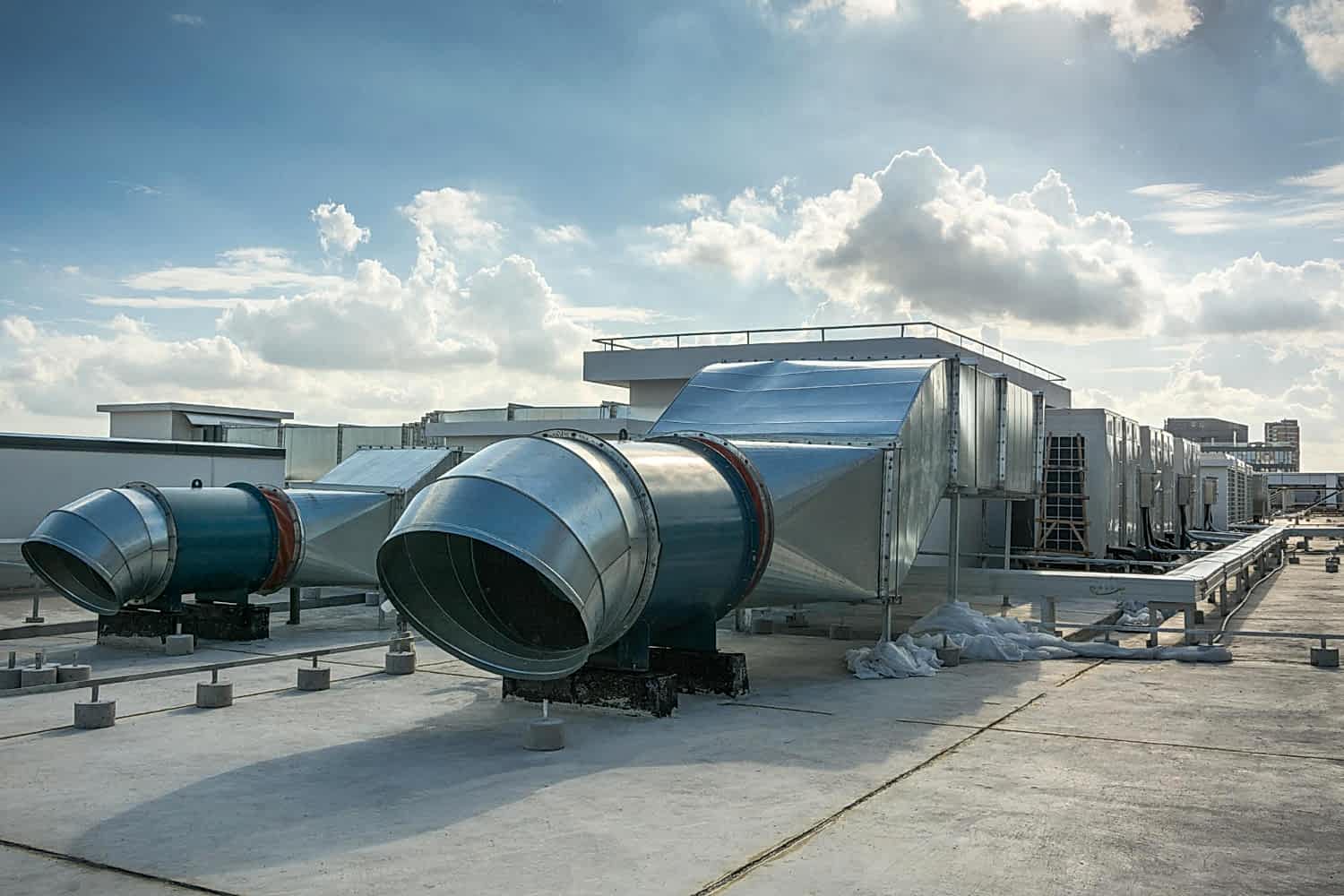
AIR CONDITIONING
Providing a high "indoor air quality" is the main purpose of almost all HVAC systems. In terms of the meaning attributed to "indoor air quality" within the framework of this article, "high indoor air quality"; It defines keeping the thermal characteristics of the ambient air and the organic or chemical pollutants in the ambient air within the limits necessary for human comfort and health.
THERMAL CHARACTERISTICS: The parameters of the environment and the ambient air, which are necessary for comfort and personal performance, and which affect the process of radiating energy from the human body are called thermal characteristics.
Dry bulb temperature
Relative humidity
ambient air movement
Whether the temperature is homogeneous
temperature of radiation surfaces
are counted among the thermal characteristics. Among other factors, these characteristics are a natural function of temperature and humidity control, the way the supply air is supplied to the environment (air distribution system), the temperatures of the room surfaces, the dynamics of heat transfer between the environment and its surroundings, and the "tightness" of the construction (infiltration properties).
CONTAMINANTS: As it is known, air consists of 78% nitrogen, 21% oxygen and 1% “other” gases, among which gases such as carbon dioxide and various chemical compounds. Indoor pollutants can be evaluated in one of the following three categories.
Category 1; Contaminants produced in the environment – These types of pollutants often have an identifiable source in the environment. Carbon dioxide, biological odors and synthetic aromas originating from people in the environment; cigarette smoke; volatile organic compounds from adhesives and other substances; solvents and cleaning agents; chemicals from process or storage origin; and odors formed during cooking are included in this category.
Category 2; Environmental pollutants introduced into the environment – When dealing with such pollutants, first of all, the type of pollutant and then the ways of entry into the environment should be investigated. Carbon dioxide, sulfur dioxide, industrial chemicals and solvents are in this group. The most common way these pollutants follow to reach the environment is; 1) building openings that serve a specific purpose, such as windows and doors, 2) building openings that do not serve a specific purpose, such as leaks on the windowsill, and 3) the outside air used by the ventilation system.
Category 3; Organic pollutants that reproduce in the environment – These types of pollutants are the most common, the most dangerous and unfortunately the least understood group, but they occur in areas with high humidity and suitable temperatures. General forms of these pollutants can be counted as germs and mold. Since these three categories of pollutants in an HVAC system have to be handled differently from each other, they will be referred to as Category 1, 2, and 3 pollutants for the purposes of this article.
VENTILATION AIR
When properly designed and operated, the concept of “mixing volume” before the air conditioner, as the point of introduction of outside air into the system to dilute Category 1 pollutants, may be a “perfectly” valid concept for simple systems 50 years ago. Considering the complexity of the systems, this concept is not technically sufficient. Today's buildings require multiple zoning and operating rates where 100% cooling load is reduced to zero and then zero heating load reaches 100% value. The same system, in most cases, has to operate in a hot and humid climate at one time of the year, and in a very cold climate at another time of the year. If the psychrometric control requirements under these variable conditions are analyzed, it will be concluded that the "mixing volume" under these requirements is not perfect. Beyond that, our reliance on this technology is one of the main reasons for the occurrence of microbial pollution (category 3) in air conditioning systems and air-conditioned buildings. In many cases, the lack of thermal comfort has simply been recognized as a "limitation" of air conditioning technology.
The following definitions apply within the framework of ventilation air:
1) Ventilation “air” is the air supplied to the environment from outside in order to reduce the level of pollutants in the environment to a certain value.
2) A “humid climate” is a climate where the vapor pressure in the outside air exceeds the ambient design vapor pressure at any time of the year.
ALTERNATIVE: Let's assume that a building where an air conditioning system will be installed is in a hot and humid (35 C DB / 25 C YT) region in summer and a cold and dry climate in winter. It should be noted that the building construction is too tight (enifiltration is very low) and that the ventilation should be completely independent from the control of the ambient temperature, and that the dehumidification process must be used to provide other thermal comfort conditions in the environment.
Let me also point out that it will not be done with pleasure or system.
CONTROL OF AMBIENT TEMPERATURE: Almost all HVAC engineers will think that providing thermal comfort under these assumptions is fairly simple and inexpensive. What is required is an efficient air distribution system and sensible cooling and heating designed in accordance with the following equation.
Q =( cfm) (1.08) (delta t)
Q: sensible heating or cooling load , Btuh
Cfm= air circulation flow rate
Delta t=temperature difference between supply air and room air,F
If this design were to be made with a central fan system serving more than one zone control, a variable air flow system (VAV) could be used. The only control mechanism that would be needed would be the discharge side thermostat controlling the valve of the cooling coil. Since the dehumidification process was provided separately, the battery could basically run "dry" and the temperature of the discharge air could be adjusted according to the temperature required for the zone that needed cooling the most. VAV terminals could be equipped with a reheat option to assist the requirements of the air distribution system, if needed or to provide heating of the environment during the winter months. Whether any unheated zone will need such reheating can be determined by dynamic load analysis.
From the air handling unit to room control, this type of system is quite simple and inexpensive. It uses a minimum level of components and a minimum level of control points.
It is of course possible to use other systems with similar success and simplicity. Since there is no need for dehumidification or ventilation, any circulation system that applies an on-off or proportional control algorithm will continue to operate effectively as long as air distribution is provided well.
Variable-capacity diffusers, fan-coil units, heat pump units, radiant heating or cooling panels or circulation PTAC units are examples of such systems. Since all of these systems will provide only sensible heating or cooling, the possibility of creating a suitable environment in which category 3 pollutants can grow, as in today's systems, will also be eliminated.
Regardless of its form, this system can be called an ambient temperature control (OSK) system.
HUMIDITY CONTROL AND VENTILATION:
Theoretical analysis of the air conditioning problem of today's buildings in humid climates will reveal that there is a natural link between conditioning the air taken from outside and controlling the indoor humidity.
For buildings located in a humid climate, it is necessary to consider:
In most buildings, the main source of water vapor in the indoor environment is the outside air taken into the system.
If the entry of unconditioned outdoor air into the environment can be prevented, the water vapor emerging in the environment will be the only load.
If a "dry" environment is accepted, the only source of water required for microbial reproduction will be water vapor introduced into the environment by any means.
If there is no water vapor ingress into the environment in any way, and if the water vapor emerging in the environment can be removed with the dry air given to the environment, there will be no humidity to support microbial reproduction in the environment.
Therefore, in a humid and hot climate, the moist air taken from outside should not be given to the cooled environment without being properly dehumidified. In this context, “appropriate dehumidification” is the reduction of the moisture content of the air so that the dew point temperature of the air is below or equal to the dew point of the ambient air. Since the ventilation air is completely taken from outside, as a result, all of the outdoor air supplied into the building must be reduced to a specific humidity value (dew point temperature) that is equal to or lower than the desired humidity value of the ambient air. This is the natural link between the conditioning of the outside air and the control of ambient humidity. In the previous paragraphs where the control of ambient temperature was discussed, the hypothetical requirement was established that the ventilation requirement and humidity control should be evaluated separately in the design of a system to provide environmental comfort. In this case, the next step is to meet this requirement. At this point, the necessity of circulating ambient temperature control systems and another air conditioning and distribution system with the following features is applied.
All of the outside air required to meet the ventilation requirements of the environment must be supplied to this unit.
All of the air entering the building passes through the ventilation-air conditioning unit.
In hot and humid weather, all of the air supplied to the building with the VAC unit must be dehumidified in such a way that it reaches the desired dew point temperature or below this point.
If the environment needs to be humidified in cold and dry weather, the humidification process should be done entirely in the VAC unit.
The process of cleaning particles and chemicals from the outside air is also completely done by VAC.
should be carried out in
DISTRIBUTION SYSTEM;
What is needed in the use of the VAC unit, which feeds the conditioned air directly to the volumes, is, in its simplest form, low-capacity ducts and air distribution system. may be sufficient to create
Another approach, where a single VAC unit is used in conjunction with multiple ambient controllers, is to feed the air from the VAC unit into the ambient temperature controller's return airflow. This option has two disadvantages:
The required amount of outside air may increase due to the “multi-media syndrome”.
The sensible cooling capacity of the ventilation air cannot be added to the cooling capacity of the circulating air, so as to reduce the flow requirement of the ambient temperature control unit. However, apart from the possible energy impact, which is the first disadvantage, in both cases, it can be considered as an increase in investment cost that can be balanced with the economy of the discrete distribution system.
MIX VOLUME
The mixing volume is a device added to the air handling unit in order to deliver the conditioned “ventilation air” to the environment simultaneously with the conditioned circulating air in order to regulate the temperature and humidity of the environment.
Problem: In a multi-zone air conditioning unit, the introduction of "ventilation air" into the system through the mixing volume imposes some restrictions on the system design options.
In case the air handling unit feeds more than one volume, the outdoor/return air percentages in the mixing volume will be determined according to the requirements of the environment that needs the highest outdoor air ratio.
In hot and humid climates where the specific humidity value of the outdoor air exceeds that of the indoor air, the mixing volume will humidify the circulation air.
In a unit with on-off or by-pass control, the above situation will cause the system to humidify the environment.
Humidification of the indoor environment in cold climates will cause harmful condensation in the mixing volume if the temperature of the mixed air falls below the dew point temperature of the indoor air.
If the specific humidity value of the outdoor air exceeds that of the indoor air, all of the ventilation and circulating air must be cooled below the design dew point temperature to ensure humidity control of the environment.
If there are pollutants in the outdoor air that require chemical filtration, it should be sized to filter all of the ventilation and circulation air, since the chemical filter is placed after the mixing point.
Conclusion: In hot and humid/cold climates, the use of the “mixing volume”, which is placed before the air conditioning unit and allows mixing of the return air and the outside air, basically shows some deficiencies and the concept presented in this study will be more useful in practice. Basically, this concept
1) Thermal comfort and
2) It envisages the use of two systems in order to reliably provide acceptable indoor air quality. The VAC system is a system that uses 100% outside air and must provide all the required “ventilation air”. Although it is the only point where the outside air is taken into the building, it should contain particle and gas filters to prevent Category 2 pollutants from entering the building, and the ambient humidity should be controlled entirely through this unit.
The ambient temperature control unit, on the other hand, should be designed for sensible heating or cooling and should be used to control the ambient thermal comfort parameters other than the humidity level. Humidity control should be left entirely to the VAC unit.
Correctly designed systems based on the proposed concept will provide a very high degree of indoor air quality and thermal comfort at a lower investment cost in general air conditioning applications or applications requiring precise control of temperature and humidity.
Source: Thermodynamics, 2000, issue 97
Posted by William J.Coad
